
Specialized Care
Alzheimer's & Dementia Home Care in Southeast Michigan
By Austin AdairReviewed by Greg Adair, MHAJune 2026
Dementia rarely arrives as the dramatic diagnosis families expect. It arrives as a burnt pan, a missed Tuesday, the same story twice in five minutes. Our caregivers step into that quiet emergency with the training, patience, and routine that lets your loved one stay home — and lets the family caregiver finally sleep.
What Changes at Home
Dementia is a routine problem, a safety problem, and a family problem — in that order
The moments families remember are the dramatic ones—a parent who walked out at 2 a.m., a spouse who forgot the grandchildren's names on Thanksgiving. But the day-to-day work of dementia care is quieter: the steady morning routine, the conversation that doesn't correct a confused memory, the chair set out so a slow walk doesn't become a fall.
A trained caregiver in the home doesn't cure dementia. We don't replace the neurologist or geriatrician or memory-care clinic. We carry the long hours in between — the redirection at 4 p.m. when sundowning starts, the patient setup of a familiar activity, the safety sweep at bedtime, the documentation that lets your family have an honest conversation about what comes next.
Our Dementia Care Approach
Six areas where a trained caregiver moves the needle
Every dementia care plan we write covers these six areas, adapted to the stage of disease, the specific dementia type, and what your loved one's day actually looks like right now.
Structured Routines & Cueing
A consistent daily rhythm — wake, meals, hygiene, activity, rest, sleep — reduces anxiety and the behavioral symptoms that come with cognitive change. Caregivers cue gently, use familiar language, and never argue with a confused moment.
Sundowning & Behavioral Support
Late-afternoon agitation has predictable triggers: fatigue, low light, unfamiliar noise. We brighten the room, drop the stimulation, redirect to a familiar comfort, and document the pattern so the family can plan the next day around it.
Wandering & Home Safety
We sweep the home for trip hazards, install or check door alarms and motion lights, secure medications and cleaners, and watch entry points during the higher-risk evening hours. Every plan documents wandering history and elopement response.
Cognitive Engagement & Meaningful Activity
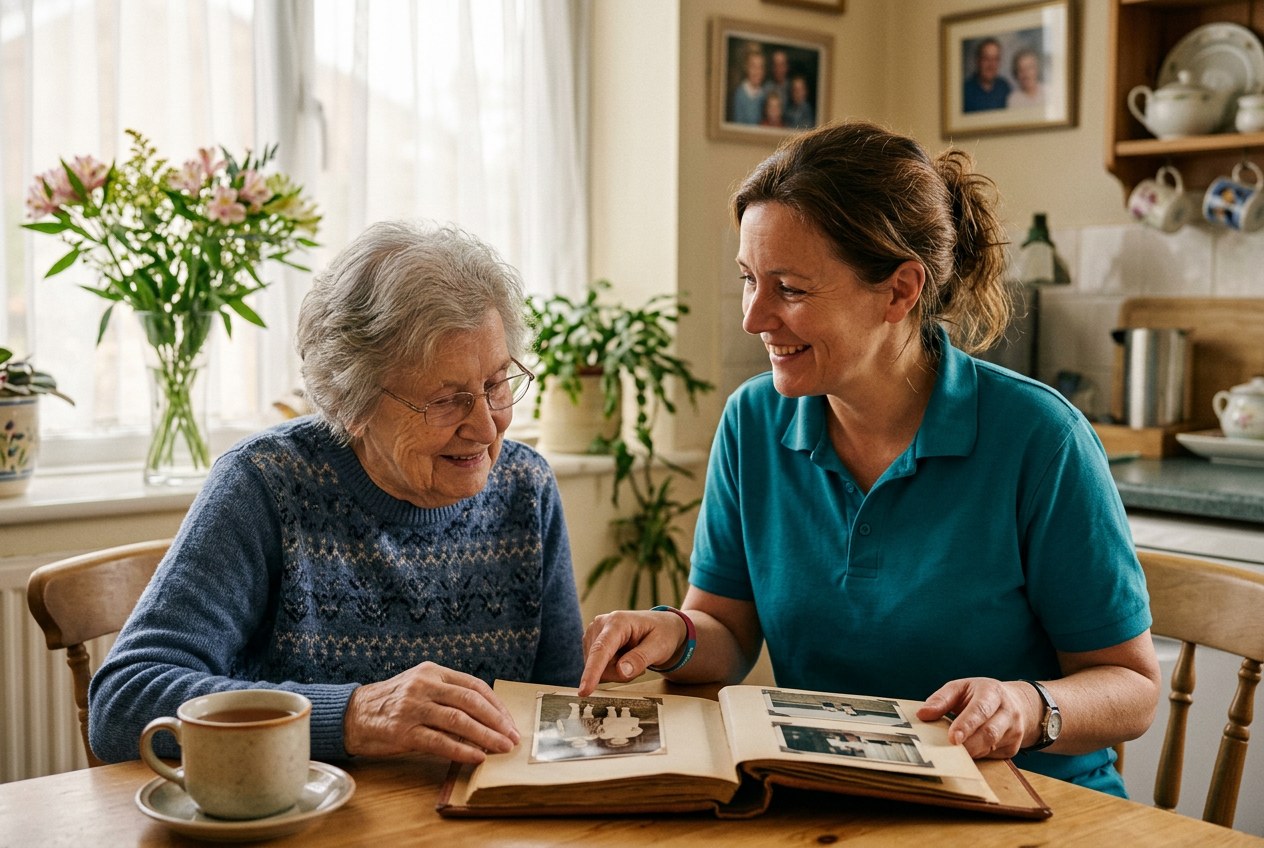
Music from your loved one's era, folding laundry, sorting buttons, looking through a family photo album, gentle gardening — the activity matters less than the dignity it preserves. We follow what your loved one still enjoys, not a generic worksheet.
ADLs at a Dementia-Aware Pace
Bathing, dressing, toileting, and grooming are common flashpoints because they feel intimate and unfamiliar. We slow down, narrate every step, hand the toothbrush to the right hand, and protect the dignity of the moment.
Family Education & Respite
Spouse and adult-child caregivers exhaust themselves first. We schedule predictable respite blocks, teach the redirection techniques that work, and document what we see so family conversations with the neurologist or geriatrician are grounded in data.
Training & Credentials
A proprietary dementia training program — recognized by the Alzheimer's Association
Every dementia caregiver we send completes an Alzheimer's Association–recognized training program built around evidence-based, person-centered practices, and our on-staff Certified Dementia Practitioner supervises the care plan before the first shift so families feel the training in the first hour, not the first month.
Our caregivers complete an Alzheimer's and dementia care training program recognized by the Alzheimer's Association (alz.org) for incorporating evidence-based, person-centered recommendations.
The curriculum is a proprietary, in-house program — not an outside certification we resell. It was built around the realities of Southeast Michigan homes and the behaviors our care team sees every week: sundowning patterns, wandering and elopement triggers, sleep-cycle disruption, end-stage comfort techniques, and the redirection language that protects dignity during ADLs. Every caregiver completes it before being placed on a dementia case.
Our care team also includes a Certified Dementia Practitioner on staff who oversees care planning for clients with Alzheimer's, Lewy body, frontotemporal, vascular, Parkinson's-related, and Huntington's-related dementia.
Read more about how we vet and train every caregiver on our caregivers page.
A Typical Day
What a dementia day looks like with the right help
- 8:00 a.m. — caregiver arrives, opens curtains, greets by name, and begins the familiar morning routine: toileting, washing up, dressing in clothes laid out the night before.
- 9:00 a.m. — breakfast at the kitchen table with the radio on a familiar station. Caregiver sits, eats with your loved one if invited, never rushes the meal.
- 10:30 a.m. — a meaningful activity: folding laundry, sorting buttons, a few pages of a familiar photo album, light gardening on the porch. The activity matters less than the dignity.
- 3:30 p.m. — the room is brightened, snack offered, stimulation dropped before sundowning typically starts. We never wait for agitation to arrive.
- 6:00 p.m. — dinner, a calm wind-down activity, evening hygiene, door-alarm check, and the consistent bedtime that anchors the whole next day.
- All shift — visit notes documented and shared with family. Behavioral patterns, food intake, and any incidents flagged for the family and physician.
Our Standard
Held to the 12-Mile Care Standard
Every dementia caregiver we send is held to the 12-Mile Care Standard — the same five-principle, named methodology we apply to every client in Southeast Michigan. Skills are verified in real time by a Registered Nurse before the first dementia shift, including transfer technique, redirection language for an agitated moment, sundowning response, and the elopement protocol the family has approved.
The 12-Mile Care StandardRelated Neurodegenerative Conditions
Other cognitive conditions we support
Alzheimer's is the most common dementia, but it's not the only one. Our trained caregivers and our on-staff Certified Dementia Practitioner support families navigating Lewy body, frontotemporal, vascular, Parkinson's-related, and Huntington's-related dementia — each with a different care plan:
- Lewy body dementia — visual hallucinations, day-to-day cognitive fluctuation, and Parkinson's-like motor symptoms.
- Frontotemporal dementia (FTD) — earlier-onset personality and language changes that often present long before memory loss.
- Vascular dementia — stepwise cognitive decline following stroke or chronic small-vessel disease.
- Parkinson's disease dementia — cognitive symptoms layered onto motor decline; see our Parkinson's care page.
- Huntington's disease — combined movement, cognitive, and behavioral symptoms in mid-life or later. Our caregivers support both the movement and the cognitive components.
What it costs
Dementia home care pricing in Southeast Michigan
Across Southeast Michigan home care agencies, hands-on dementia care typically falls within the Personal Care range of $29 - $37/hr. When care includes complex behavioral support, sundowning coverage, or two-person transfers, area providers generally move to the Specialized Care range of $35 - $42/hr.
For 24-hour situations, many families move to live-in care, which averages $400 - $500/day among home care companies in the greater Detroit area.
Run your exact schedule through our cost calculator to see weekly and monthly numbers, or contact us for a free consultation.
FAQ