
Specialized Care
Parkinson's Home Care in Southeast Michigan
Parkinson's doesn't move on the clock — but levodopa does. Our caregivers are trained in the small, time-sensitive details that decide whether a day is mostly "on" or mostly "off": dose-window reminders, freezing-of-gait cueing, and protein timing.
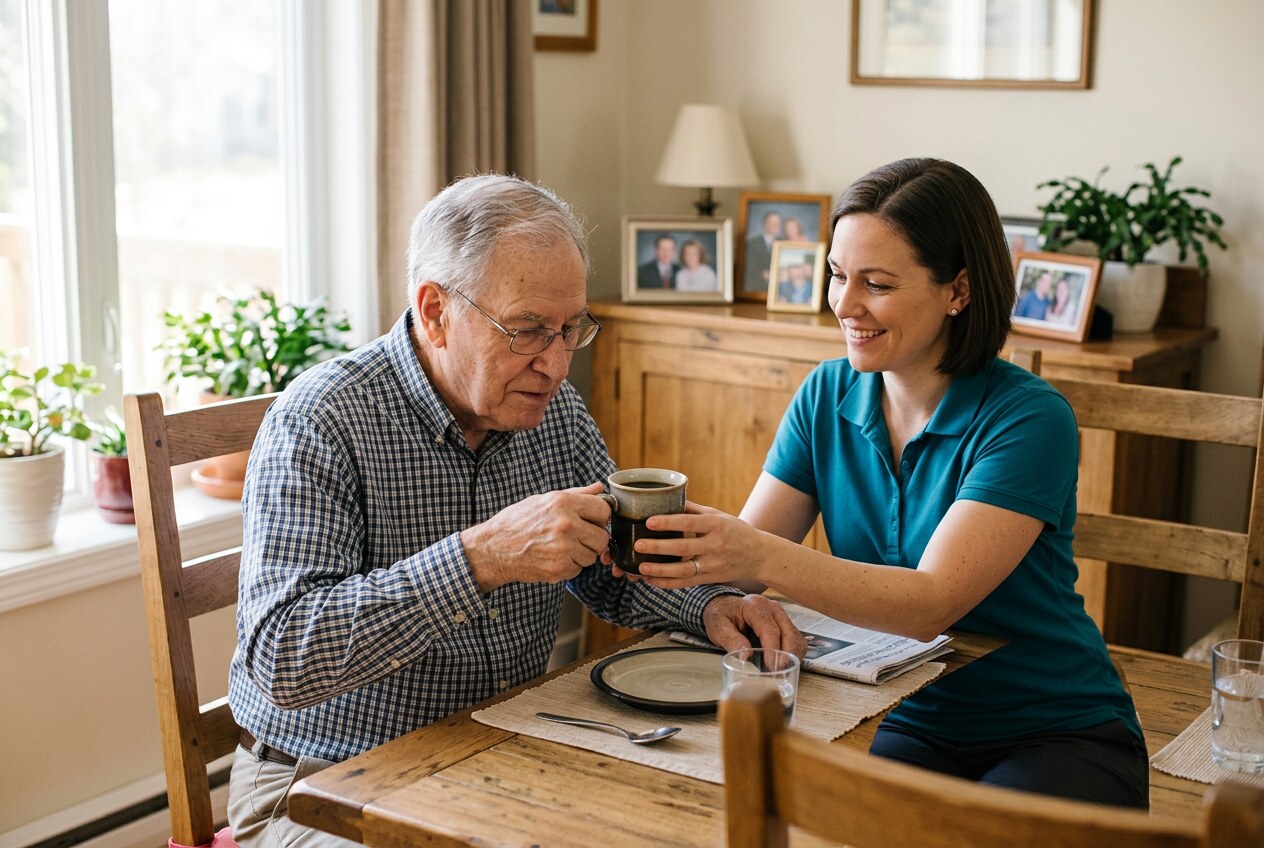
What Changes at Home
Parkinson's isn't a tremor problem — it's a timing problem
Families often arrive expecting Parkinson's care to be about the visible tremor. In practice, the day-to-day work is about timing: getting the levodopa dose in on schedule, protecting a 30-minute meal window, recognizing the early signs that an "off" period is starting, and engineering the home so a slowed step doesn't become a fall.
A trained caregiver in the home can be the difference between a hospital admission for a hip fracture and a quiet Sunday morning. The skill isn't dramatic — it's a steady arm at the bathroom doorway, a visual floor cue in the hallway where freezing tends to happen, and the willingness to slow down so your loved one can keep their dignity.
Our Parkinson's Care Approach
Six areas where a trained caregiver moves the needle
Every Parkinson's home care plan we write covers these six areas, adapted to the stage of disease, the neurologist's instructions, and what your loved one actually wants their day to look like.
Mobility, Gait & Fall Prevention
Caregivers cue rhythmic stepping, give one-arm assist through doorway 'freezing' episodes, and pre-clear walking paths. We follow LSVT BIG-style 'big step, big arm' cueing your therapist may already have introduced.
Medication Timing Reminders
Parkinson's medications are time-sensitive — a late dose can mean an extra hour of 'off' time. We deliver written dose reminders on the schedule your physician set, never as nursing administration.
Speech & Swallowing Support
We prompt LSVT LOUD vocal exercises if prescribed, encourage chin-tuck swallowing, slow the pace of meals, and watch for coughing or wet voice that should be reported to the speech-language pathologist.
Nutrition & Protein Timing
Protein can blunt levodopa absorption. We help schedule the heavier protein meal away from the on-time dose window your neurologist recommends, and keep small frequent snacks easy to reach.
Exercise & Daily Movement
Daily movement slows progression. We encourage prescribed PT/OT home exercises, walk loops in the home, and stationary cycling — whatever your loved one's care team has approved.
Home Safety & Freezing Episodes
We remove throw rugs, add visual floor cues at thresholds where freezing tends to occur, place a chair every 20–30 feet for rest, and rehearse a calm response if your loved one falls.
A Typical Morning
What a Parkinson's morning looks like with the right help
- 7:00 a.m. — caregiver arrives 30 minutes before the first levodopa dose, opens curtains, sets out water, and previews the day's schedule so the medication can take hold before standing up.
- 7:30 a.m. — medication reminder given on the prescribed schedule. Caregiver then waits 20–30 minutes for the dose to take effect before assisting with the transfer to the bathroom.
- 8:00 a.m. — bathroom and dressing with one-arm assist, slow pace, no rushing through the bedroom doorway where freezing has happened before.
- 8:45 a.m. — light breakfast (eggs, toast, fruit) kept low-protein so the dose isn't blunted. Caregiver watches pace and posture, prompts chin-tuck swallows if needed.
- 9:30 a.m. — prescribed PT exercises, a few loops of the living room, and the LSVT BIG "big step, big arm" cues if your therapist has trained them in.
- All day — visit notes documented and shared with family, with any missed dose windows or new freezing locations flagged for the neurology team.
Our Standard
Held to the 12-Mile Care Standard
Every Parkinson's caregiver we send is held to the 12-Mile Care Standard — the same five-principle, named methodology we apply to every client in Southeast Michigan. Skills are verified in real time by a Registered Nurse before the first Parkinson's shift, including transfer technique, gait-assist with a freezing client, and medication-reminder protocol.
The 12-Mile Care StandardFor families looking specifically at memory symptoms in Parkinson's, our team also includes a Certified Dementia Practitioner on staff who oversees care planning for clients with Parkinson's disease dementia or Lewy body dementia.
What it costs
Parkinson's home care pricing in Southeast Michigan
Hands-on Parkinson's support typically falls within the Personal Care range that licensed home care agencies in Southeast Michigan typically charge, averaging $29 - $37/hr. When the care plan includes more complex elements — advanced-stage transfers, swallowing supervision at every meal, or coordinated dementia support — pricing typically moves into the Specialized Care range, averaging $35 - $42/hr.
For overnight coverage and 24-hour situations, see live-in care.
Run your exact schedule through our cost calculator to see weekly and monthly numbers, or contact us for a free consultation.
FAQ