
Specialized Care
Stroke Recovery Home Care in Southeast Michigan
Recovery from a stroke happens in the months after rehab discharge — not just inside the therapy hour. Our caregivers carry the exercises forward between PT and OT visits, lead safely from the stronger side, slow down for aphasia, and keep the bathroom safe so the recovery isn't undone by a single fall.
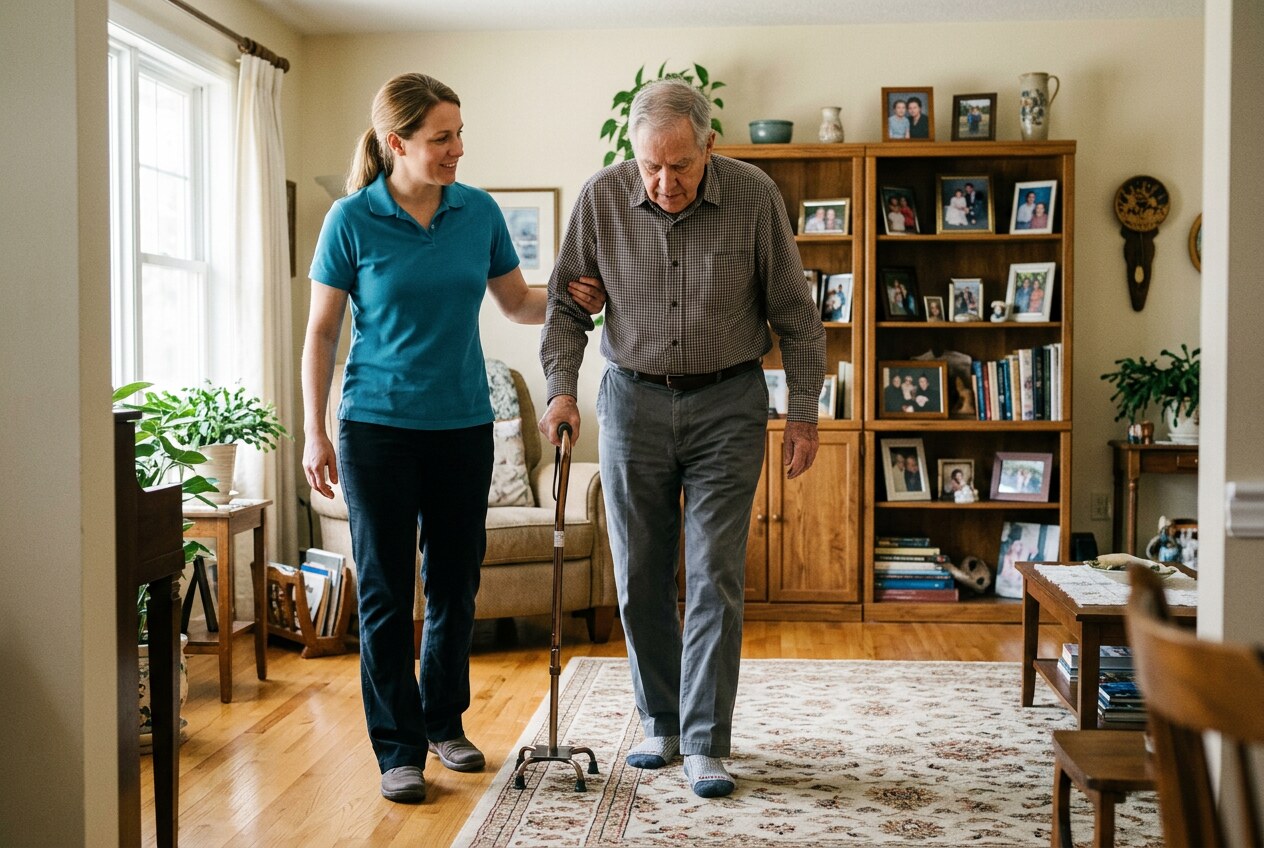
What Changes at Home
The hardest months are after rehab discharge
The inpatient rehab unit was structured: three hours of therapy a day, nurses checking vitals, an aide for every transfer. Then discharge happens, home health arrives twice a week for PT and OT, and the rest of the day — bathing, dressing, meals, medication timing, getting to the bathroom safely — falls to the family.
A trained caregiver in the home fills that gap. We follow the PT's transfer plan, we carry the OT's hand exercises forward, we watch for the small changes (new slurring, drooping, sudden weakness) that need to be reported, and we keep the bathroom and kitchen safe — because one fall in week three can erase six weeks of progress.
Our Stroke Recovery Approach
Six areas where the right caregiver protects recovery
Every stroke recovery plan we write covers these six areas, adapted to the deficit pattern (left vs. right hemisphere, motor vs. language vs. cognitive), the home health team's instructions, and what the day actually requires right now.
Safe Transfers & One-Sided Weakness
Hemiparesis changes how every transfer happens. We use the gait belt, transfer board, or stand-aid your PT recommended, lead from the stronger side, and protect the affected shoulder from being pulled.
Therapy Carry-Over Between PT/OT Visits
Home health PT and OT visit twice a week. We carry the exercises forward the other five days — the seated marches, the sit-to-stands, the reach-and-grasp drills — so progress doesn't stall between visits.
Aphasia-Friendly Communication
When speech is slow or words are stuck, we slow down too. We use yes/no questions, a communication board, pictures, or written choices, and we give the time it takes — without finishing sentences.
Cognitive & Visual Field Awareness
Left-side neglect, slowed processing, and short-term memory gaps are common after stroke. We approach from the unaffected side at first, then gradually cue toward the neglected side as the OT directs.
Fall Prevention & Bathroom Safety
Strokes raise fall risk dramatically. We install nothing — but we use what's there: grab bars, raised toilet seat, shower bench, non-slip mats, clear pathways, and the gait belt on every transfer.
Emotional Recovery & Post-Stroke Depression
Up to a third of stroke survivors experience depression. We watch for withdrawal, tearfulness, and loss of interest, document what we see, and report changes to the family so primary care can act early.
A Typical Day
What a recovery day looks like with the right help
- 7:30 a.m. — caregiver arrives, gait belt on, supervised transfer from bed to bedside commode and back, lead from the stronger side.
- 8:30 a.m. — bathing on the shower bench, affected side closest to the wall, dressing with adaptive techniques the OT taught.
- 10:00 a.m. — the seated marches, sit-to-stands, and reach drills the PT prescribed, counted and documented.
- 12:00 p.m. — lunch on the swallow plan (chin tuck, slow pace, thickened liquids if ordered), watching for any new symptoms.
- 2:00 p.m. — the hand exercises the OT left, the word-finding practice the SLP recommended, then a real rest.
- All shift — visit notes documented and shared with family; any new symptom triggers a call before the shift ends.
Our Standard
Held to the 12-Mile Care Standard
Every stroke recovery caregiver we send is held to the 12-Mile Care Standard — our five-principle, named methodology applied to every client in Southeast Michigan. Skills are verified in real time by a Registered Nurse before the first shift, including gait-belt transfer technique, two-person assist, shower bench bathing, and aphasia-friendly communication.
The 12-Mile Care StandardWhat it costs
Stroke recovery home care pricing in Southeast Michigan
Stroke recovery care typically falls within the Personal Care range among Southeast Michigan home care agencies, averaging $29 - $37/hr. When the care plan includes two-person transfers, complex equipment, or significant aphasia support, rates typically move to the Specialized Care range Southeast Michigan home care agencies typically charge, averaging $35 - $42/hr. For 24-hour situations, live-in care is $400 - $500/day.
Run your exact schedule through our cost calculator or contact us for a free consultation.
FAQ